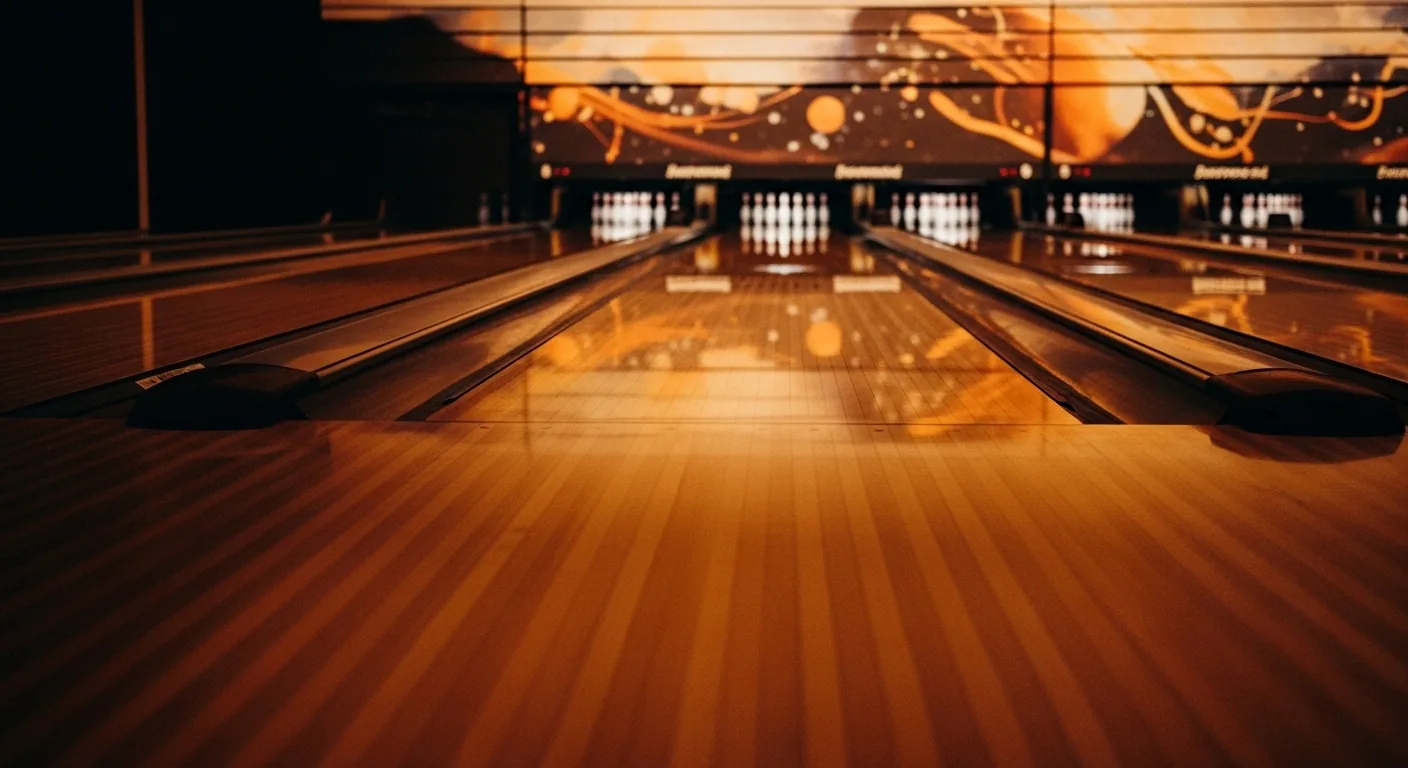
How oil gets on the lane
Before play, centers apply a thin layer of lane conditioner (oil) using a machine that lays it down in a precise, programmed pattern. The oil isn't spread evenly — it's distributed in a deliberate shape that varies across the lane's width and down its length. You can't see it, but it's the single biggest factor in ball motion.
Why oil matters: slide vs. grip
The rule is simple: oil makes the ball slide; dry boards make it grip and hook. Where the oil is heavy, your ball skids and conserves energy. Where it thins out — usually toward the pins and along the edges — friction takes over and the ball hooks. The pattern decides where on the lane that transition happens, which is why the same ball behaves completely differently on different patterns. (Foundation: lane anatomy.)
House patterns: forgiving by design
The everyday pattern at your local center is the house shot (or 'typical house pattern'). It's built to be fun and forgiving: it concentrates oil in the middle of the lane and leaves the outside boards drier. This creates a funnel effect — a ball thrown too far right hits dry boards and hooks back toward the pocket; a ball pulled left finds oil and holds. House patterns flatter imperfect shots, which is why recreational and most league scores look high.
Sport patterns: flat and demanding
Sport patterns (used in serious competition) are flatter — the oil is distributed far more evenly across the lane's width, removing the friendly funnel. There's little margin for error: miss your target by a couple of boards and you're punished. This is why pro scores on a sport pattern can look 'low' compared to a house shot — they're bowling on a fundamentally harder canvas. The gap between the two is enormous and explains a lot of confusion casual fans have about pro scoring.
Pattern length and what it changes
A pattern has a length — how far down the 60-foot lane the oil extends (often expressed in feet). Length dramatically changes strategy:
- Shorter patterns (oil ends sooner) give the ball more dry lane to hook on, so it hooks earlier and more — you typically play straighter and more direct to control it.
- Longer patterns (oil extends further) leave less dry lane, so the ball hooks later and less — you often play with more angle and a stronger ball to get it to read.
Knowing the pattern length tells you roughly where your breakpoint will be and how much hook to expect before you ever throw a shot.
Reading the pattern as you bowl
You can't see the oil, so you read your ball's reaction. Watch the breakpoint — where it stops sliding and starts hooking:
- Ball hooks too early and comes up short (left of pocket for a righty)? Less oil than you played for, or too aggressive a ball.
- Ball slides too long and misses right? More oil, or not enough hook.
Every shot is a data point. Good bowlers treat the first few frames as information-gathering, then commit to a line. Detail in lane play.
Transition: the pattern changes as you bowl
Oil doesn't stay put. As bowlers throw shots, balls carry oil down the lane and into the dry areas — the pattern breaks down and 'transitions.' What worked in game one may not work in game three. Recognizing transition (and moving with it — usually inward for a righty as the outside dries up) is a defining skill. Standing still while the lane changes around you is the most common way good bowlers lose.
Matching your ball to the pattern
This is where equipment and oil meet. Heavier or longer oil rewards a stronger, earlier-reading coverstock; drier or shorter patterns call for a weaker, cleaner ball that won't over-hook. Serious bowlers carry multiple balls precisely to match conditions — or adjust one ball's surface to change how early it grips. See how the materials differ in bowling balls, and the urethane-vs-reactive tradeoff in that comparison.
Where to start as an improving bowler
You don't need to memorize pattern charts to benefit. Start by simply noticing: does your ball hook early or late tonight? Is the house shot letting you get away with misses? When you bowl somewhere new and the ball behaves differently, that's the pattern talking. Build the habit of reading reaction, learn a basic move or two from lane play, and the rest develops with experience.
Want the plain-English version first?
Our blog post What Are Oil Patterns? covers the basics without the depth — a good warm-up to this guide.