Home / Technique / Aiming & Targeting

Core skill

How to aim: targeting that actually works.

Where you look decides where the ball goes. Most bowlers improve instantly just by changing what they aim at — here's the targeting system the best bowlers use.

How to aim: targeting that actually works

Spot bowling beats pin bowling

Pin bowling (staring at the pins 60 feet away) is how most beginners aim, and it's the hard way. Spot bowling — aiming at a spot on the lane close to you, like an arrow — is far more accurate because the target is near. Pick a spot and roll over it; trust that the rest of the lane does its job.

Using the arrows

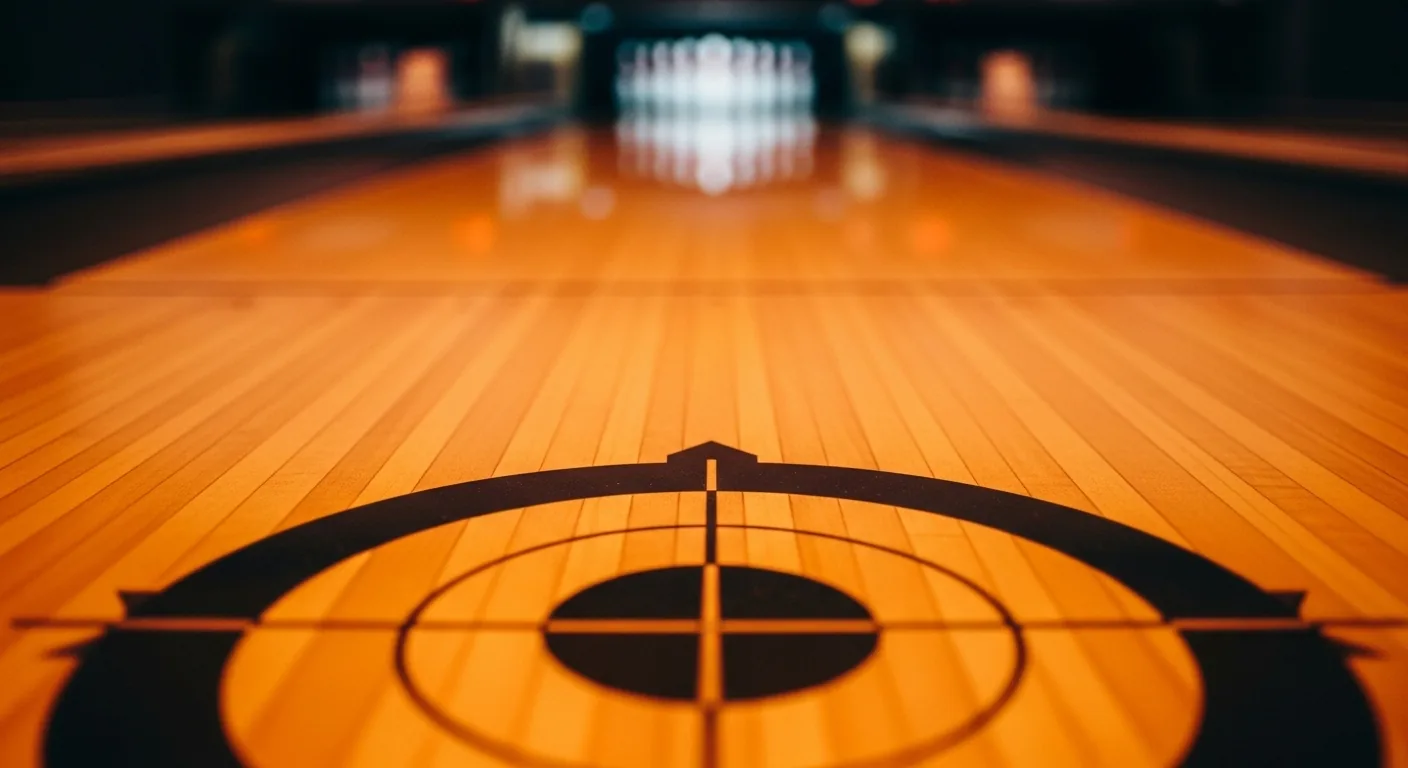
The seven arrows sit about 15 feet out on boards 5, 10, 15, 20, 25, 30, 35. A right-hander throwing fairly straight often targets around the second arrow from the right (board 10). As your hook develops, your target shifts. The arrows are your primary aiming reference.

Counting boards

The 39 boards let you describe your aim precisely: 'standing on 20, targeting 10' means your slide foot is on the center board and you're rolling over the tenth board at the arrows. Thinking in boards is what makes adjustments possible.

Finding your strike line

Your strike line is the path that sends the ball into the pocket. Find it by experimenting: note where your feet start, where you target, and where the ball ends up, then adjust until pocket hits repeat. Once you know your line, you can move off it predictably for spares and lane changes.

Adjusting your target

When the ball misses, move your target or feet rather than changing your swing. The common rules of thumb (like moving feet and target a set number of boards) let you chase the pocket as oil transitions. A repeatable swing plus smart target moves beats trying to steer every shot.

Where the markings actually are

Every target you aim at is set by the USBC Equipment Specifications Manual, and the manual gives ranges, not single numbers. That is worth knowing, because the arrows in one center can sit a foot or more from where they sit in another.

MarkingWhere (measured from the foul line)How many
Approach dotsRows at 2 to 6 inches, 3 to 4 feet, 6 to 7 feet, 9 to 10 feet, 11 to 12 feet and 14 to 15 feet behind the lineUp to 7 per row
Lane dots6 to 8 feet past the lineUp to 10
Arrows (targets)12 to 16 feet past the line, evenly spaced in a uniform patternUp to 7
Downlane markers33 to 44 feet past the line, no wider than one boardUp to 4

Two practical uses. If the arrows feel too far away to hit consistently, the lane dots 6 to 8 feet out are an even closer spot on the same boards. And the downlane markers, where a center has them, give you a second reference much farther down the lane, a way to describe where your ball is going after it passes the arrows.

Your strike target also anchors your spares. USBC’s 3-6-9 spare system keeps the target on the lane the same as for your strike ball and moves only your feet, three, six or nine boards. The spare calculator does that arithmetic for any leave.

Sources: USBC, Equipment Specifications and Certifications Manual (last updated 03/26), “Lane and Approach Markings or Designs”; USBC coaching, 3-6-9 Spare Conversion System.

Keep going

DisclosureBowl Revolution is reader-supported. When you buy through links on our site, we may earn an affiliate commission at no extra cost to you. As an Amazon Associate we earn from qualifying purchases.