Home / Tools / Retro Score Sheet
Printable
Retro Bowling Score Sheet: Keep Score by Hand
Some bowling centers still hand you a pencil, and plenty of bowlers miss it. Customize a Bowl Revolution score sheet, print it, and keep score the way bowlers did before the machines took over.
Preview
How to keep score by hand
A score sheet gives every bowler a row of ten frames. Each frame has a small square in its upper right-hand corner, and USBC's playing rules still describe scoring in terms of that square. Write your first-ball count next to the square and your second-ball count inside it. The big space underneath holds your running total.
- X Strike: all ten on the first ball. Mark an X in the small square and leave the first-ball spot empty.
- / Spare: the rest of the pins on the second ball. Mark a slash in the square.
- - Miss: the second ball knocked nothing down. Mark a dash.
- 8 Split: circle the first-ball count when it leaves a split. USBC says a split is "usually designated by a (0)", a circle, but any symbol will do.
- F Foul: you stepped over the foul line. The ball counts as a delivery, but none of the pins it knocked down count. F is the usual mark.
The math, frame by frame
The only tricky part is that strikes and spares are scored later. A frame with a strike or spare stays open until the bonus balls are thrown:
- Open frame: just add the pins from both balls.
- Spare: 10 plus the pins from your next one ball.
- Strike: 10 plus the pins from your next two balls. Two strikes in a row (a double) give the first one 20 plus the next ball. Three in a row (a turkey) give the first one 30.
- 10th frame: a strike or spare earns you the extra balls right there, up to three balls in all. Twelve strikes in a row is a perfect 300.
Here's a full game, worked the way you'd write it with a pencil:
Practice a few games on paper and you'll start to see why bowlers used to talk about "marks": count your strikes and spares and you can guess your score before you add it up. Want to check your math? Use our score calculator, or read how bowling scoring works.
Before the machines
For most of bowling's history, the math was your job. USBC recalls that bowlers "would get out the grease pencil and hand score league sessions and even tournaments." In many centers the sheet wasn't even yours to keep. A 1961 patent application for a better score sheet, US Patent 3,170,719 by Herman I. Kraus, explains that after you finished, "the bowling establishment takes up the score sheet for their own purposes," as a record for its accounting. His fix was a sheet with tear-off sections so bowlers could take their scores home.
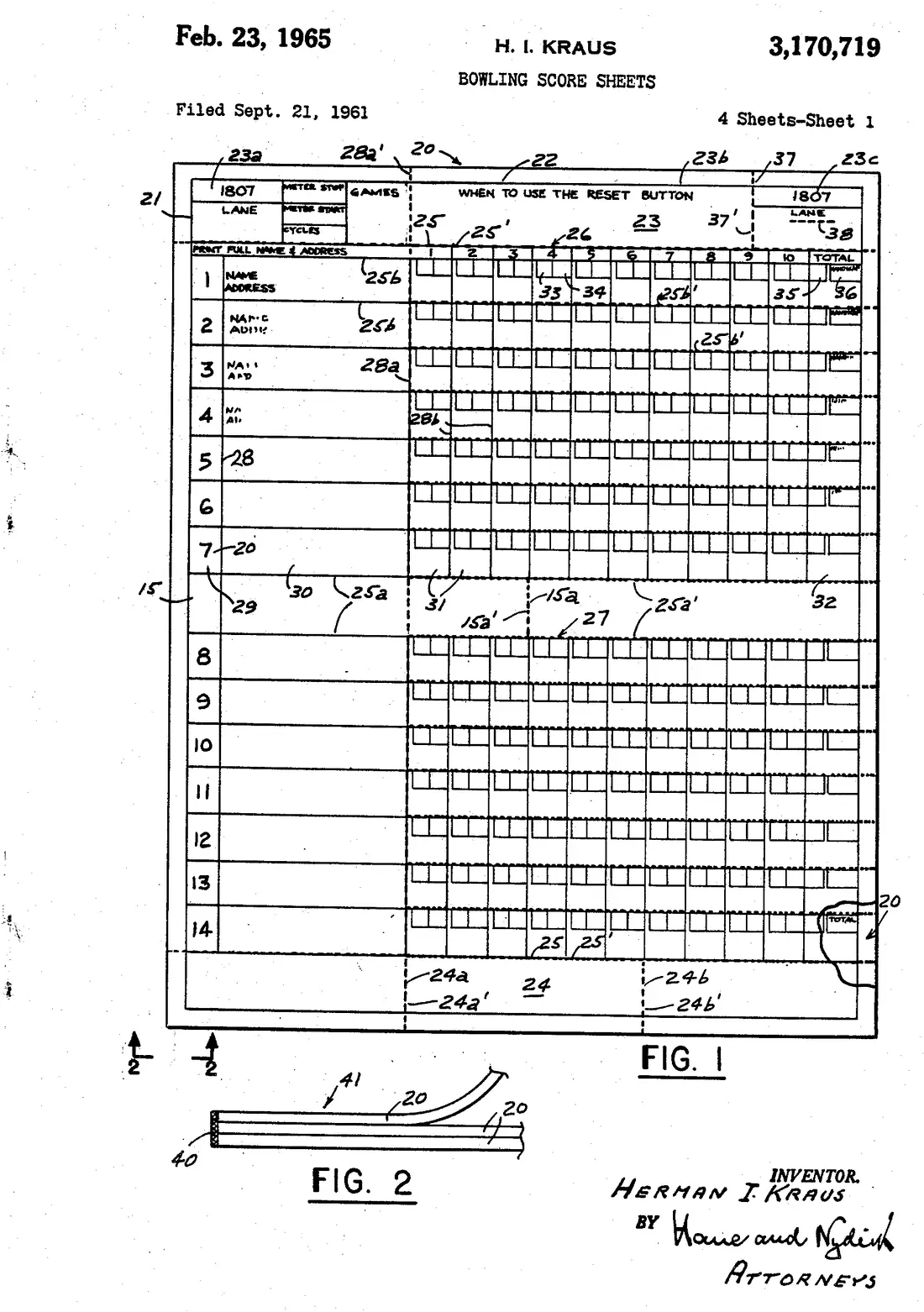
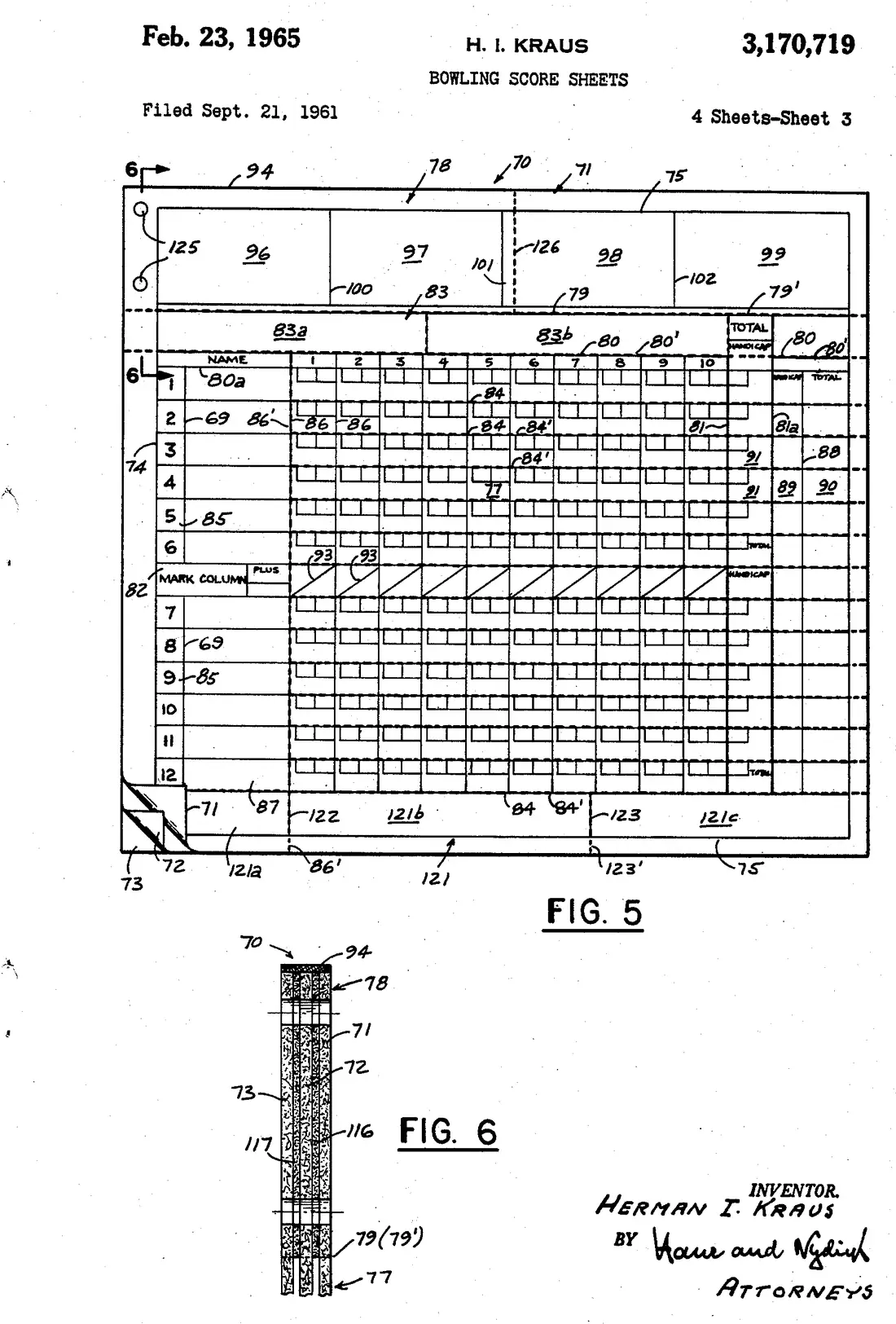
Drawings from US Patent 3,170,719, H. I. Kraus, “Bowling score sheets” (filed 1961, granted 1965), public domain. Tap a drawing to see it full size, or read the full patent.
Electronic scoring arrived in 1967, with a field test at Village Lanes in Chicago, and spread through bowling centers during the 1970s. Even then it took a while to win everyone over: USBC's own Open Championships didn't use automatic scoring until 1979. Today the screens do the adding, but the marks they show, the X, the slash and the circled split, are the same ones bowlers wrote in pencil.
Why keep score yourself?
Because it's part of the game. Keeping score teaches you exactly what a strike or a spare is worth, and why a spare in the 9th frame matters so much. It keeps everyone at the table paying attention to each other's shots, and it's a nice bit of mental math between frames. If your center still has pencils, or you're bowling somewhere the scoring is down, print a sheet and bring it along.
Sources: USBC Playing Rules, Rules 2 and 5a; USBC, Bowling's Evolution; H. I. Kraus, US Patent 3,170,719, "Bowling score sheets" (filed 1961, granted 1965); Automatic scorer, Wikipedia.