The basic idea
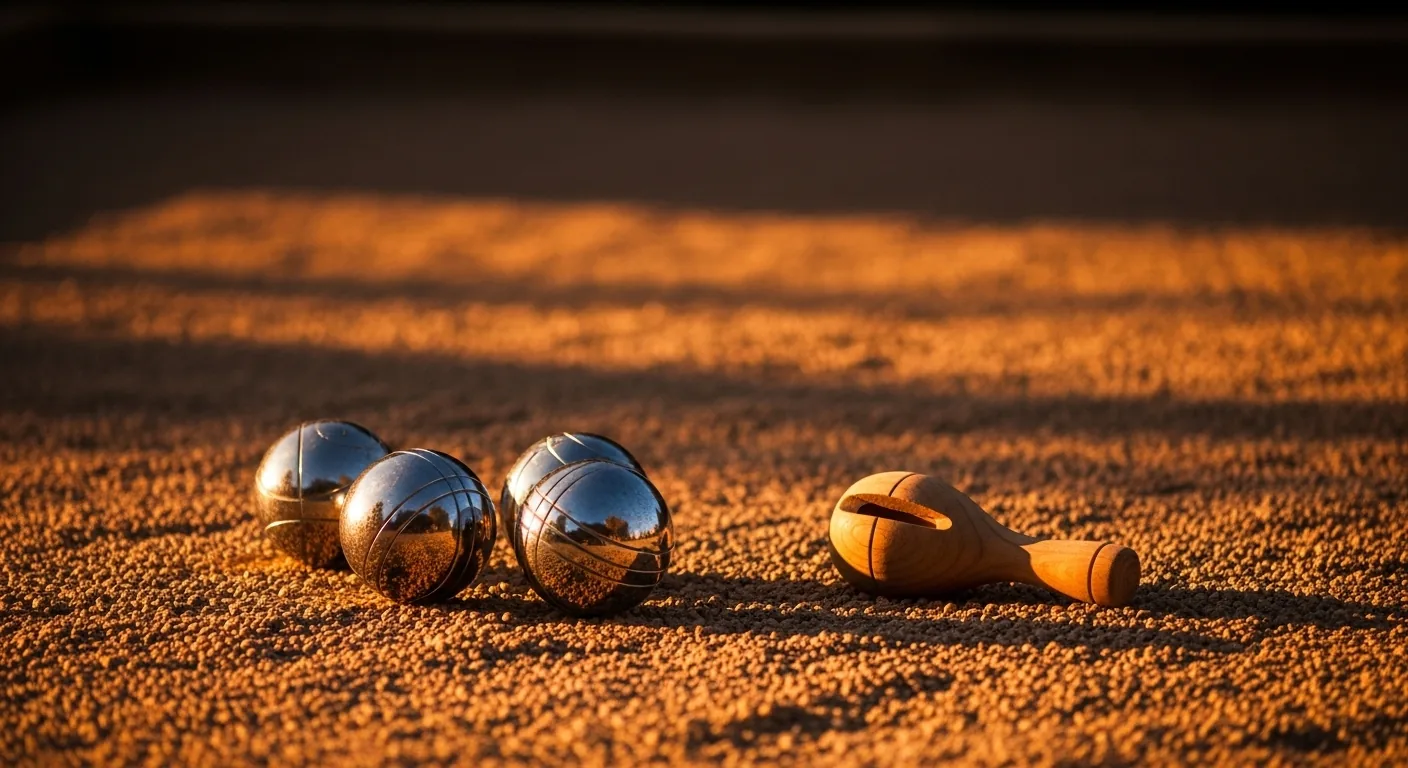
Pétanque belongs to the wider boules family. Players throw hollow metal balls, trying to land them closest to a small wooden target ball — the cochonnet (also called the jack or 'piglet'). As in bocce and lawn bowls, the team with the ball nearest the target scores.
The stationary circle
Pétanque's defining rule: you throw with both feet together, stationary, inside a small circle drawn on the ground. There's no run-up or approach — the French name derives from a phrase meaning 'feet together.' This makes the game accessible to nearly anyone and shifts the emphasis entirely to touch, aim, and tactics rather than athleticism.
Pointing and shooting
As in the other boules games, two shot types dominate. Pointing (placing) is a careful lob to rest your ball near the cochonnet. Shooting is a hard, precise throw to knock an opponent's well-placed ball out of position — ideally hitting it cleanly while your own ball stops dead (a 'carreau,' the game's most admired shot). The interplay of pointers and shooters within a team is the heart of pétanque strategy.
The metal balls
Pétanque balls are hollow steel, smaller and harder than bocce balls. Serious players choose ball size, weight, and hardness to suit their role (pointers and shooters favor different characteristics). The metal construction allows the precise high-impact shooting that defines the game, and gives pétanque its distinctive ringing clack.
Surface and setting
Pétanque is played on hard, gravelly ground rather than a manicured lawn — the rougher, less predictable surface is part of the challenge and means a perfectly flat court isn't required. This is partly why it became such a fixture of public squares and casual play: almost any patch of packed dirt or gravel works.
Its place in the family
Pétanque, bocce, and lawn bowls are cousins descended from the same ancient impulse to roll toward a target, each shaped by its region — France's gravel squares, Italy's courts, Britain's greens. Together they form the 'green and ground' branch of the rolling-games family that sits alongside pin bowling. See the shared roots in our origins guide.